
Beacon Extract: From Shifting Mandates to Policy Action: Master Regulatory Change
Regulatory change management software automatically ingests new circulars, master directions, and amendments — from RBI, SEBI, IRDAI, or under DPDPA, ISO 27001, SOC 2, or GDPR — works out what applies to your business, and maps it directly into your existing policies and controls. It plugs into the SIEM and HRM systems you already run, so there’s no ripping out and replacing existing tools, and no dedicated compliance officer required.
Where Things Break
Regulations move faster than solo compliance owners can manually respond.
New laws, amendments, circulars, and clarifications are issued frequently by multiple governing bodies, often with short implementation timelines. Without a dedicated legal or compliance team, keeping up with what’s changed — and whether your controls still hold up — becomes a part time job on top of your actual one.
Slow, Manual Interpretation
Reviewing dense legal updates is slow and inconsistent across business units without a shared regulatory intelligence system for centralized monitoring.
Policy Gaps and Overreaction
Without risk prioritized signals or a structured change management workflow, teams either over update unnecessary controls or miss critical gaps entirely.
Compressed Implementation Timelines
Tight enforcement windows leave risk teams little room for thorough manual impact analysis — the exact case for automated regulatory change management.
Inadequate Impact Assessments
Regulators frequently cite weak or fragmented change impact assessments as a key program deficiency — the gap a proper impact assessment tool is built to close.
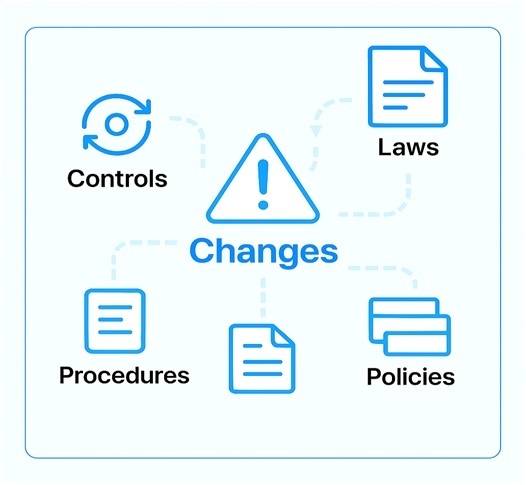
Tracking regulatory circulars without a compliance officer
Beacon Extract’s Unified Regulatory Repository consolidates circulars, master directions, and amendments from RBI, SEBI, IRDAI, and other regulators into a single, continuously updated library — so a business without a compliance officer doesn’t need to manually check each regulator’s website or bulletins from outside vendors. The engine updates automatically across jurisdictions and pairs each incoming update with your active control systems, so tracking and impact context arrive together.
The Beacon Extract Approach
A structured regulatory change management framework for teams without a compliance department
Unified Regulatory Repository
Only what’s relevant reaches you
Automated Requirement Parsing classifies every incoming circular, amendment, or master direction against your entity type and existing control set before it reaches you — so only what’s actually relevant surfaces, and a routine circular is told apart from a master direction amendment that changes a binding obligation.
Dynamic Impact Assessment
Exposure measured against live systems, not a snapshot
Dynamic Impact Assessment runs cross references styled after a circular impact assessment against your internal control libraries and policy manuals, using live SIEM/HRM telemetry — not a static snapshot — to determine your exact exposure to a given change.
Automated Policy Gap Discovery
Gaps surface during normal operation, not the audit
Automated Policy Gap Discovery continuously flags missing, partially addressed, or redundant controls using active performance telemetry and audit data — so gaps surface as part of normal operation, not during the audit itself.
Intelligent Remediation Guidance
Remediation tied to the exact policy delta
Legal analysis of the change is translated into remediation tasks laid out step by step, and regulatory update tracking assigns them across departments with clear ownership — tied to the exact policy delta, not a generic checklist.
What Sets Beacon Extract Apart
Most regulatory tracking tools stop at “something changed.” Beacon Extract goes further.
Beyond tracking
Knowing a circular was published isn’t the hard part — knowing whether it applies to your business is. Beacon Extract parses which parts apply to you, runs the impact assessment against your live control environment, and generates owned remediation tasks in the same workflow.
Nothing to rip out
Many platforms ask you to migrate into a new system of record. Beacon Extract is built to connect to the SIEM and HRM systems you already run, so there’s nothing to install and nothing to replace.
Beyond a notification feed
A live updates feed tells you something changed. Beacon Extract tells you whether it applies to you, exactly what it affects, and who owns fixing it — before an auditor asks.
Built on live data
Static trackers work off a manually maintained record. Beacon Extract pairs regulatory tracking with live telemetry from your own systems, so impact assessments reflect what’s actually deployed today.
Integrates with your existing SIEM and HRM systems
Beacon Extract connects directly to the SIEM and HRM systems you already run to pull live control and personnel data, rather than requiring a migration to a new siloed platform. No ripping out and replacing existing tools, no new system for your team to learn, and impact analysis reflects what’s actually deployed rather than a manually maintained spreadsheet.
Q ASKED OFTEN
What actually counts as a regulatory change that needs tracking?
Not every update matters the same way. A circular is just a note. A master direction is the current rulebook. An amendment changes a rule you already have to follow. Beacon Extract tells them apart automatically, so nothing gets missed and nothing gets overreacted to.
| Type | What it means | What you'd normally do | What Beacon Extract does |
|---|---|---|---|
| Circular | A routine update or clarification | Skim it, usually no action needed | Flags it as low priority and logs it |
| Master Direction | The full, current rulebook on a topic | Check it against everything you do | Maps it against your whole control library |
| Amendment | A specific rule that just changed | Fix only what's affected | Finds the exact controls affected and fixes those |
Value Delivered
Moving from reactive analysis to structured regulatory change management
Accelerated Change Evaluations
Shorten evaluation cycles from weeks to days with automated legal analysis paired with centralized tracking data.
Focused Policy Refinements
Modify only the specific policies an amendment actually affects — avoiding over remediation through dependency mapping.
Defined Compliance Accountability
Assign regulatory update tasks across departments with clean ownership through automated workflows and notifications.
Can we prove every tracking decision if an auditor asks?
Maintain full traceability for every tracking decision — supported by system log references and continuous evidence.
What is regulatory change management software?
Software that automatically monitors new regulatory circulars, decides which ones apply to your business, and maps the change into your existing policies and controls — instead of a person reading every update manually.
Do I need a compliance officer to track regulatory changes?
No. Beacon Extract does the initial reading, filtering, and mapping automatically, so a founder or ops lead can review and approve instead of starting from a blank circular.
Accelerated Change Evaluations
Shorten evaluation cycles from weeks to days with automated legal analysis paired with centralized tracking data.
Focused Policy Refinements
Modify only the specific policies an amendment actually affects — avoiding over remediation through dependency mapping.
Defined Compliance Accountability
Assign regulatory update tasks across departments with clean ownership through automated workflows and notifications.
Can we prove every tracking decision if an auditor asks?
Maintain full traceability for every tracking decision — supported by system log references and continuous evidence.
What is regulatory change management software?
Software that automatically monitors new regulatory circulars, decides which ones apply to your business, and maps the change into your existing policies and controls — instead of a person reading every update manually.
Do I need a compliance officer to track regulatory changes?
No. Beacon Extract does the initial reading, filtering, and mapping automatically, so a founder or ops lead can review and approve instead of starting from a blank circular.
Proof
Organizations using automated regulatory impact mapping have:
Reduced regulatory response timelines by weeks
Automated parsing and impact mapping shrink the gap between a circular being published and a policy being updated, since the analysis starts the moment the change lands rather than when someone gets to it.
Improved consistency in impact assessments
Running every incoming change through the same automated cross reference against internal controls and policies means the assessment doesn’t vary by who happened to review it that week.
Entered audits with clearer justification and documentation
A continuous, timestamped record of what changed, what it affected, and who acted on it replaces a scramble to reconstruct the reasoning after the fact.
Proof
Proven outcomes across industries
Uncovered data missed during years of manual tracking
50%+
Improved response timelines significantly